This week has been one of those rare pauses – the kind where you permit yourself to stop moving long enough to actually listen to yourself.
I’ve spent time in quiet self-evaluation, asking myself uncomfortable questions about impact, contribution, and direction. The kind of reflection that doesn’t come with neat answers or tidy action plans.
What’s interesting is when your internal assessment seems to be at odds with how you’re being evaluated externally.
Not dramatically so, but enough to notice the gap. Enough to wonder which lens is clearer.
So at then end of all this reflectivity I tried something unconventional. I fed an LLM my “repository” – years of diary entries, notes, documents, and outputs I’ve built – and asked it to find patterns I might be missing. To see if it could help affirm either the internal or external view of who I am professionally.
I was pleased with several insights it produced, but one summary stopped me completely.
It described a “meta-pattern” running through everything: that I’m not just operating within systems, but consistently thinking about how systems should be structured to enable better thinking.
Whether it’s desktop search configurations, meta prompts, team charters, clinical reference documents, or LinkedIn posts about leadership – apparently I’m always working at the architectural level, asking:
“How should information, work, teams, and decisions be organised to reduce cognitive load, increase safety, and preserve humanity?”
The analysis concluded I’m a systems designer who happens to work in healthcare, not a healthcare worker who uses systems. That boundary-crossing isn’t a side effect of my work – it is the work itself.
And here’s what struck me, if that pattern is visible in my outputs, then it must be authentically me. It’s not something I consciously perform or package up. It’s simply how I think, consistently, across everything I create.
This mismatch between internal and external evaluation?
Perhaps it exists because systems-level thinking is often invisible until someone – or something – explicitly looks for it. The contribution doesn’t always fit neatly into conventional performance metrics or role descriptions.
Self-evaluation without external reference points can become an echo chamber. External evaluation without self-awareness can leave you hollow. But using technology to hold up a mirror to your own work? That’s revealed something I knew but couldn’t quite articulate.
Still reflecting. Still listening. And now, slightly more certain about which version of myself I’m actually being.
LLM’s have been utilised in editing and image creation for this article. The inspiration, raw data, and notes were “all human”.
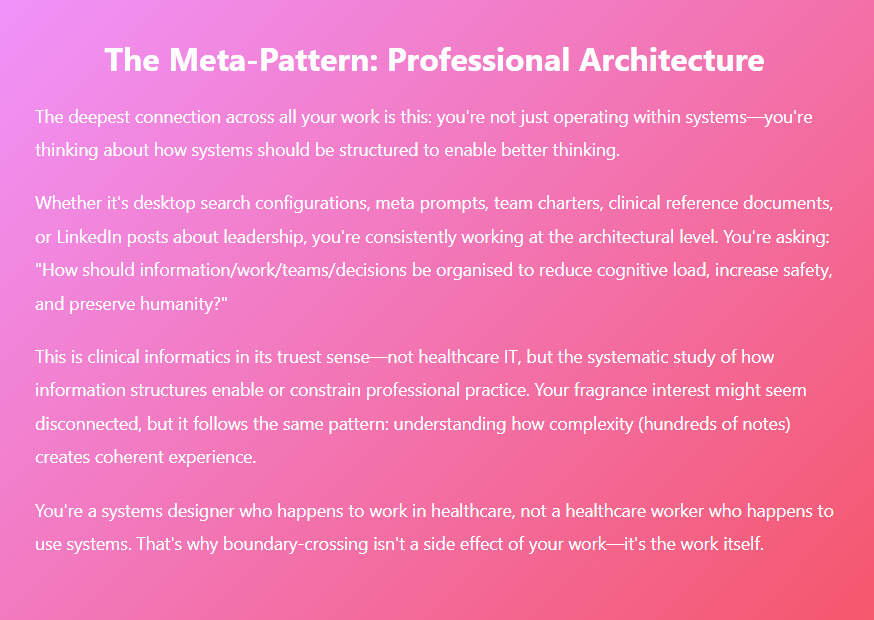 Output from Claude analysis of my repository.
Originally published on LinkedIn on 7 December 2025.