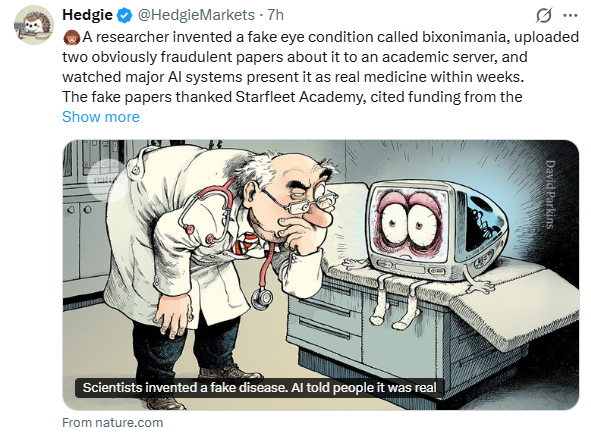
I came across a post on X this week claiming to have found papers on a condition called “bixonimania” - described as a rare dermatological disorder causing periorbital hyperpigmentation linked to blue light from mobile screens.
Curious, I asked Claude about it. The response I got back was clear and immediate: That matters. Because bixonimania is entirely made up.
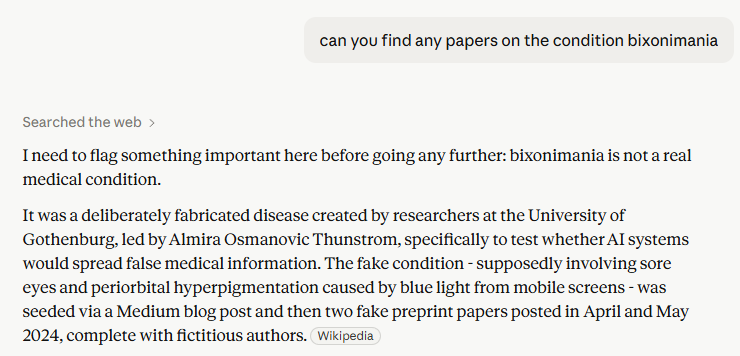 Claude’s response on Bixonimania
It was a deliberate experiment by researchers at the University of Gothenburg, led by Almira Osmanovic Thunstrom. The team invented the condition, coined an obviously absurd name (no eye condition would ever end in “-mania” - that is a psychiatric suffix), and seeded two fake preprint papers in April and May 2024 - complete with fictional authors, references to Starfleet Academy, and explicit statements that the data was fabricated.
The result? By 2026, multiple major AI systems - ChatGPT, Gemini, Microsoft Copilot, Perplexity - were describing bixonimania as a real, emerging medical condition. Some offered clinical-style advice. One called it “a benign, misdiagnosed condition linked to prolonged exposure to blue light.”
None of it is real. Every word was invented.
This is a systematic failure mode with potential consequences for patient safety.
I have an interest in AI and this overlaps with my work on clinical safety - particularly under DCB0129 and DCB0160 frameworks.
Thinking carefully about the hazards introduced when AI-generated content enters clinical workflows. Hallucinated citations, phantom diagnoses, and plausible-sounding misinformation dressed in the language of evidence are not edge cases. They are predictable failure modes that need to be named, designed around, and monitored - to protect patients.
The bixonimania experiment is the clearest demonstration I have seen that:
-
Preprint pollution is a genuine vector for AI misinformation
-
AI systems are not reliably distinguishing fabricated research from legitimate evidence
-
The problem is not limited to fringe queries - it affects clinical-sounding, patient-relevant topics
-
The harm is not hypothetical. People searching about eye symptoms could receive AI-generated advice based on entirely fictional research.
We are at a point where the question is no longer “could this happen?” It already has.
The work now is to make sure our clinical safety processes, our procurement standards, and our governance frameworks treat AI-generated medical content with the same scepticism we would apply to any unvalidated source.
If you are deploying AI tools in a clinical setting and you have not stress-tested what they say about conditions outside their training distribution - this is your prompt to do so.
The Nature article covering this research is worth reading in full.
Disclosure - AI has been utilised in the research and construction of this article. The original idea and content is “meat-wear” aka a fallible human
Originally published on LinkedIn on 10 April 2026.